
By Jonathan Scharff, Shafian Rahman and Alex Lewis
Anyone close to it knows the talk of the energy industry, technology world and increasingly business news, is now focused on Artificial Intelligence Data Centers. Where should they go? How will they be powered? What is the community benefit? Behind the announcements of billions in investment is a conversation that is starting to fragment across the nation. At Avoq, we created our own generative AI-tool, the AI Policy Pulse Dashboard, to understand state elected official sentiment towards data centers. Looking at the last 1.5 years of data, here is what we learned:
1. Sentiment Varies by Regional Geography
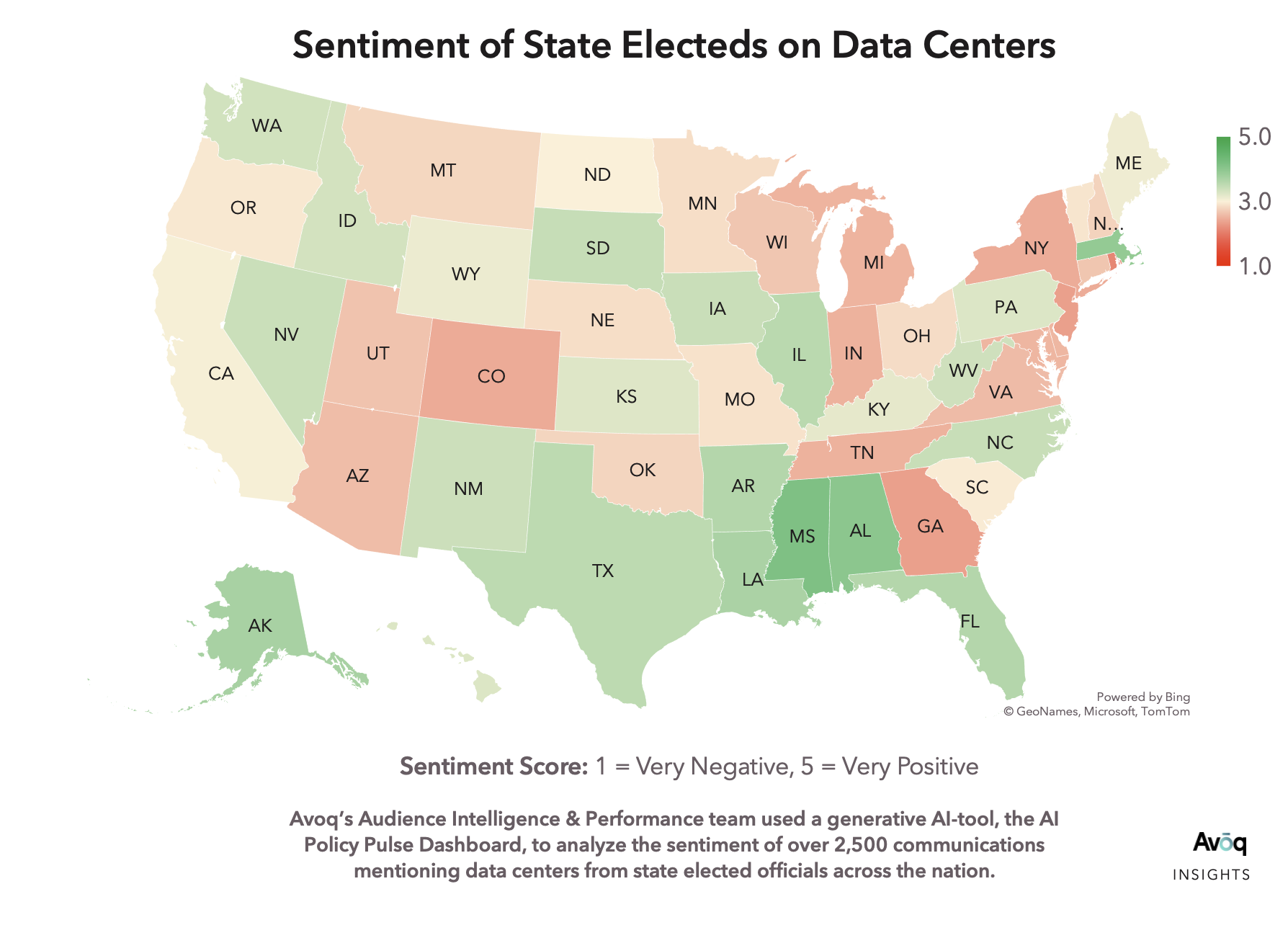
While 2025 marked the year that the overall average sentiment of Data Centers from state elected officials turned negative, these views vary significantly by state and region. Parts of the South, particularly Central-Southern states, are comparatively more favorable, while the Mid-Atlantic and parts of the Northeast emerge as higher-risk areas for the data center industry, where opposition narratives appear more established and more likely to drive pushback. State officials who are supportive of data centers most often frame them as economic development assets, tied to growth, infrastructure investment and innovation. By contrast, elected officials expressing opposition are more likely to emphasize environmental impacts, grid strain and local community costs.
- Most Favorable Region: Central-Southern States (Alabama, Mississippi, Louisiana, Arkansas, Texas, and New Mexico)
- Least Favorable Region: Mid-Atlantic (New York, New Jersey, Connecticut, Delaware, Maryland, and Virginia)
→ Implications for Businesses: Political and community sentiment is now a material site-selection risk, requiring companies to factor regional political dynamics into where (and how quickly) they invest and expand.
2. Channels Matter for Issue Framing
There is a clear divide in how data centers are discussed depending on the channel.
- Newsletters & Committee Hearings: In more formal communications including newsletters and committee hearings, data centers are largely positive or neutral: 54% of newsletters from elected officials are favorable, 22% are neutral, emphasizing economic growth, job creation, infrastructure modernization and long-term global competitiveness.
- Social Platforms: On social platforms, the tone shifts — X is the most negative channel dominated by environmental, electric grid and consumer cost concerns. Facebook is similar with 51% negative sentiment reflecting local impacts and lack of benefits concerns.
→ Implications for Businesses: How and where data centers are discussed online shapes public and political perception, making proactive, channel-specific engagement essential to building community reputation and addressing local concerns.
3. An Uneven Policy Landscape Has Emerged
Sentiment is mixed and fragile, with several states trending neutral-to-negative — meaning support for data center growth is not stable and could shift quickly as local concerns are sharing with electeds. The biggest emerging risk is a policy backlash in states where sentiment volume is weakest, potentially creating a policy environment for new restrictions, higher fees or tougher permitting tied to energy use, land impacts and water consumption.
→ Implications for Businesses: With regulatory and political support increasingly fragmented by state, data center companies must shift from a national approach to customized, state-level public affairs strategies to protect growth and reduce policy risk.
Collectively what does this mean for Data Center developers and partner energy companies? They can no longer operate without taking important steps to reduce their business risk that can emerge from community and elected official sentiment towards data centers. Each state and community requires a thoughtful approach.
Implementing a public affairs strategy is now more critical than ever. Understanding the state and local landscape, policy environment, as well as key community stakeholders and their concerns can guide site selection, community engagement and job creation benefits. However, this is also the opportunity to ultimately creating a successful partnership between data centers and communities, so we can enable the critical technologies that Artificial Intelligence will bring in the future.