
By Jonathan Scharff, Vice President and Shafian Rahman, Manager
Every March, Houston becomes the center of the global energy universe. CERAWeek draws heads of state, energy executives and policymakers from more than 80 countries. For one week, the conversations that happen in those rooms shape markets, investment decisions and policy debates for months to come.
This year, Avoq’s audience intelligence team tracked the full online conversation surrounding CERAWeek 2026 in real time — 10,330 posts from 6,270 unique authors on X, segmented by who was participating, what they were talking about and when attention spiked. What the data revealed surprised us: the energy conversation isn’t unified anymore. And for communicators, that has real consequences.
Most companies still show up to CERAWeek with one message. The data says that’s not working. Global and U.S. players are now communicating, competing and prioritizing in fundamentally different ways.
International and U.S. Participants Take Distinct Approaches
The divide wasn’t subtle. International and U.S.-based participants showed up with different goals and left with different headlines.
International players used the moment to position themselves. Their messaging centered on stability, investment opportunity and long-term partnership. Against a backdrop of geopolitical uncertainty, leaders emphasized their countries as reliable destinations for capital and collaboration. Indian energy production company, Vedanta’s Cairn, emphasized plans to invest $5 billion in U.S. services, drilling and technology. Venezuela’s opposition leader Maria Corina Machado focused on the need for “energy investment security” and transparency. Nigeria’s National Petroleum Company similarly framed the country as an increasingly attractive destination for global energy investment, alongside meetings with Chevron to advance production and deepwater expansion.
By contrast, U.S.-based companies made announcements that reflected an energy investment shift and infrastructure buildout. TotalEnergies announced a strategic shift, redirecting nearly $1 billion from offshore wind projects to U.S. oil and gas investments, in reflecting a growing trend among energy companies to prioritize traditional energy projects amid rising oil prices and geopolitical instability. Louisiana introduced its first Nuclear Strategic Framework to expand nuclear capacity and strengthen domestic supply chains. Meanwhile, major technology and energy players used the forum to advance solutions to immediate grid and capacity challenges. NVIDIA, alongside Emerald AI and utilities like AES and NextEra, unveiled a new class of flexible “AI data centers” designed to accelerate grid connectivity and improve reliability. In a separate announcement, Microsoft partnered with NVIDIA on an “AI for nuclear” initiative to streamline permitting, design and operations for nuclear energy projects.
CERAWeek 2026 made one thing clear: the energy conversation is splitting in two directions. Global players are competing for attention and capital, while U.S. leaders are racing to deliver infrastructure at scale. For communicators, a single message no longer serves both rooms — and trying to split the difference often means reaching neither.
What Comms Leaders Should Take Away
- One audience no longer exists: The idea of a single “energy audience” is breaking down. Global stakeholders are listening for signals of stability and investment opportunity. U.S. stakeholders are focused on speed, scale and execution. Messaging that tries to do both often lands with neither.
- Execution is outperforming ambition: Attention clustered around tangible actions — deals, infrastructure, partnerships — not long-term vision. Companies leading with proof points cut through the noise; those leading with broad ambition risk being ignored.
- AI has become an energy story: AI is no longer a standalone technology narrative. At CERAWeek, it showed up as a driver of energy demand, grid stress and infrastructure urgency. Communicators who treat AI separately from energy risk missing where the conversation is actually heading.
- Energy security is now a messaging priority: Security, resilience and reliability were not just policy themes — they were central to how organizations framed their value. This marks a continued shift away from purely transition-focused messaging toward a broader, more pragmatic narrative.
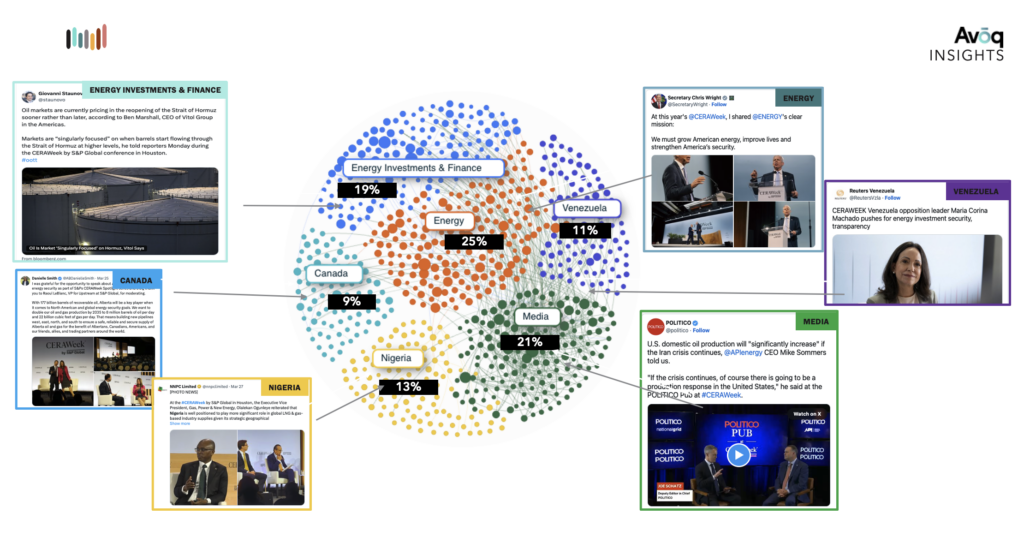
CERAWeek audience segmentation by cluster. Analysis of the top 1,000 accounts discussing CERAWeek on X, March 2026. Source: Avoq Audience Intelligence & Performance